

The graph is big. The prompt is small.
StateWeave never sends the whole graph. It compiles a bounded, causally connected view for one call.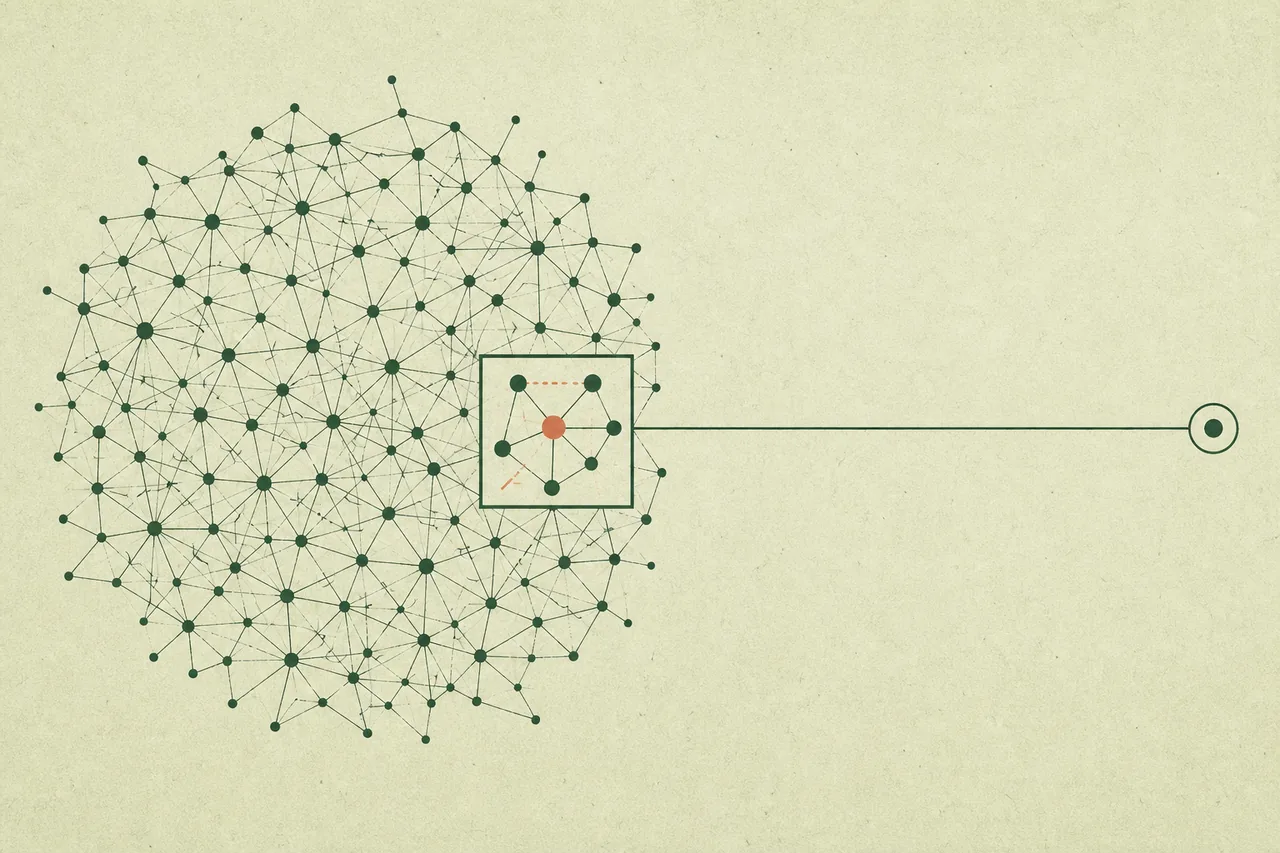
What the view keeps
The compiler selects:- system and goal roots;
- every frontier head;
- current resource heads;
- recent authoritative evidence;
- bounded operational closure;
- lexically relevant older nodes;
- a deterministic whole-graph digest.
AgentState; only the view is compact.
How it decides
The compiler targetsprojectionTargetTokens and never exceeds maxPromptTokens.
Supersession in the view
The newest resource head is authoritative. Old versions remain in the graph but do not pull their full history into every prompt. Provenance stays queryable in storage.The multi-resolution view
The publicAgent compiler now renders four deterministic layers into the
model-facing prompt:
<BIG_BRAIN>: stable topic-cluster pins for the whole graph;<PERIPHERAL>: neighboring cluster summaries around the active work;<FOCUS>: detailed nodes and causal parents selected for this turn;<TIMELINE>: recent non-structural nodes in causal sequence.
AgentState but lose projection priority.
The graph is never compacted; only this view is bounded.
Deliberate boundary.
The public
Agent chooses its focus automatically for each request. It does
not yet expose an interactive zoom/focus option. The lower-level historical
projection utility has zoom controls, but it is not the public Agent memory
engine. No embedding service or learned summary is required by the current
projection.